Barbies, Proverbs, and Vibrators
Girlhood realized in womanhood is a messy experience.

You’re invited to clutch a pearl or two while reading this.
I’m afraid I don’t have any extras on hand.
You’d find them everywhere.
In the margins of my study Bible, in my Twitter bio, in every journal I owned. In the crevices of my subconscious. In my posture, the way I talked to boys, the way I talked to myself.
The words weren’t just written down. They were embedded.
Proverbs 31.
I imagine many of us—the late bloomers in Christ—weren’t concerned with the quiet neglect our brand of self-talk created. The erosion of self-image, self-worth, self-esteem. When your entire framework for womanhood is built around restraint, there isn’t much room left for curiosity. Or for that slow, natural process of growing up. The unique and special experience of girlhood.
This sacred time in our lives was often marred by something ancient living inside of us. There was a Mosaic-law-abiding feminine living inside many of us. A version of ourselves already trained to monitor desire, to anticipate judgment, to behave as though we were being watched.
I always considered myself a girly-girl. I loved clothes, loved makeup, loved princesses and playing house and dolls and high heels. I spent a lot of my time with my mother, and much of the rest I spent by myself.
Looking back, I can see the vacuum around me. Not an absence of love (never that), but an absence of language. I didn’t have access to a framework for understanding myself that went beyond what was permissible and appropriate.
That vacuum created its own kind of conditioning.
And from it, confirmation bias.
Palatability became my goal, over authenticity. My goodness meant being pleasing and manageable, to the point where my own imperfections, my own wants and needs that existed outside of that, became things to ignore, squash, and destroy.
And I didn’t think of it as suppression then. For me, it was the path towards righteousness. In the sight of a God who also saw all of the hidden things. I conveniently tried to forget that last part.
Being true to myself was my greatest sin as a child.
But it would be my greatest triumph as a woman.
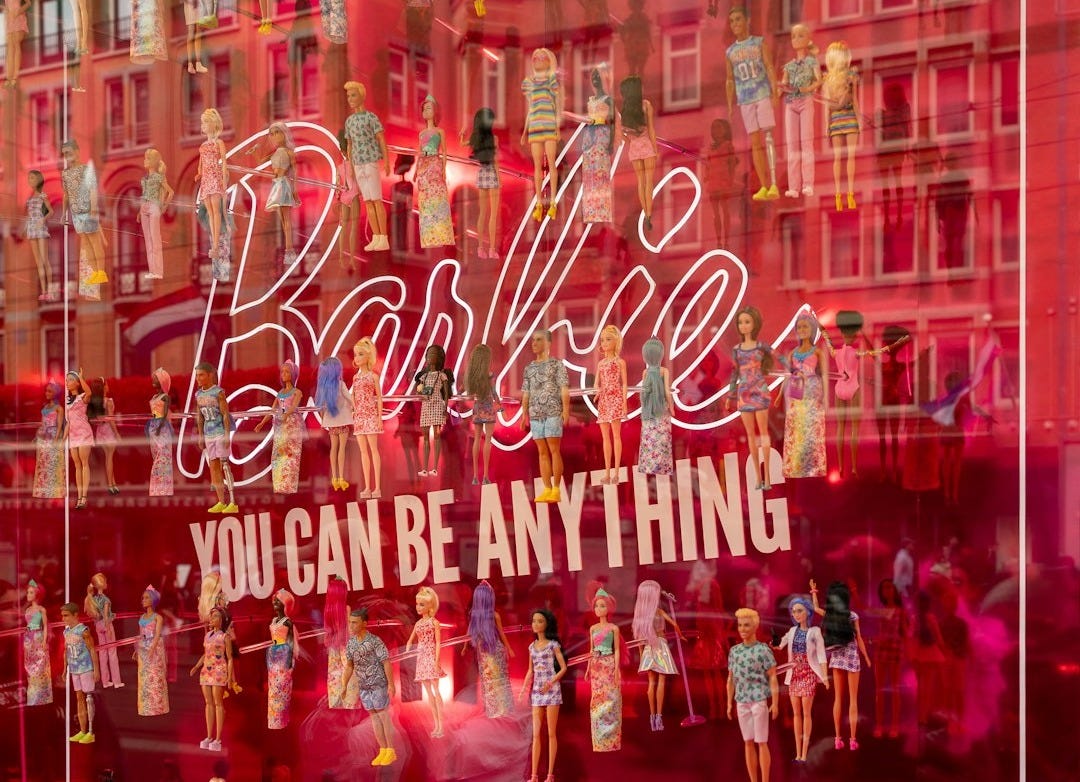
Who else grew up with Barbie?
I was obsessed with her. The dolls. The house. The castle. The clothes. The shoes. The accessories.
And the movies.
I’m a Disney girl through-and-through, but y’all…The Princess and the Pauper? With THE Martin Short cast as the villain? It’s an all-timer.
Those movies held up a mirror to so much more than the romance I dreamed of. They gave me the license to dream of a world where I didn’t have to be just a sheltered little church girl. A world where a Black girl could be bold and ask big questions. Someone soft and beautiful. And maybe even a little bit rebellious.
I gravitated toward these stories, and not because I wanted to be them. They were allowed to feel in ways I didn’t always know were available to me.
Oddly enough, I’ve found a lot of the most hidden pieces of myself in the whitest of characters. There’s a liberty, a kind of audacity, that white girlhood is allowed to carry. A freedom to be loud, messy, dramatic, and expressive. Encouragement to take up space without apology. That experience is nurtured in ways that many Black girls spend a lifetime fighting for.
It’s why Ericka, the indentured servant who longed to be a concert singer in The Princess and the Pauper, spoke to me more than Akeelah making it to the National Spelling Bee.
It’s why Laura Ingalls Wilder and her prairie-girl life in 1800s Minnesota captured my imagination more than anything Penny Proud had going on in 2000s California.
Those girls were allowed to be soft. Romantic. Dramatic. Adventurous. And somewhere inside me, I wanted that too.
I think I longed to feel feminine and alive in my own skin. Beautiful in a world that rarely modeled it for me. And I longed for that within a system that told me those things were dangerous. That a woman’s “charms,” as Proverbs puts it, were fleeting.
So while the stories I loved invited me to dream…
The theology I inherited taught me to bury those dreams, to be careful with the very parts of myself those dreams awakened.
Of course, we’re talking about Proverbs 31.
Before the Bible thumpers rush in to beat me back into submission, hear me out. I touched briefly on this passage in my last post, but it deserves a deeper look here.
Because there’s a deep intersection between how women’s worth is defined, the violent ways our bodies are viewed and interpreted across culture, and the quiet theology that shapes how we see ourselves.
Sex. Purity. Virtue.
Our worth became tied to a biological phenomenon known as the hymen. Something internal and invisible to anyone who didn’t know you intimately, yet something that felt branded into our souls for the world to judge.
Virginity becomes our dowry.
In a world where a lot of women don’t even know who their father is, let alone have one negotiating their price.
I spent the better part of my youth obsessed with the idea of purity. I owned several purity rings. My friends and I spoke often about the responsibility we carried as women to save ourselves. I crafted an identity around who I believed Proverbs 31 was calling me to be.
But my body entered the conversation early.
I sprouted breasts at nine. I started my period at eleven.
I’ve seen the celebratory scenes in movies and TV shows, where womanhood arrives like a beautiful rite of passage. That was not my experience at all.
Those moments were instead filled with anxiety and shame. My mom spent shopping trips looking for bras that wouldn’t “enhance” too much, worried about my modesty, and looking at undergarments became a mechanical and clinical process. I just needed something that would keep my nipples covered without drawing attention.
My period became another signal that my body had to be monitored, disciplined, and kept modest. I had violently painful cramps, and while my mom normalized that process for me, it was something I was taught to keep to myself. Summertime was always an awkward time for me. I had never learned to use a tampon because it was “inappropriate” for me to wear them.
By the time I reached adulthood—well into my marriage, actually—I realized something almost absurd.
I had never allowed myself to buy things, do things that made me feel good.
I never went looking for clothes that made me feel vibrant and feminine. I shied away from the dresses that showed a little leg or tops that allowed my cleavage to exist without apology.
I had grown up curvy and busty in a white Anglo-Christian suburb, constantly negotiating the tension between my body and the environment around me.
I learned early that being held tenderly was a fantasy. That longing too loudly was dangerous. That sexiness was something to manage, not embody.
And so I wrestled with the scriptures. Because I wanted to feel beautiful. And sexy. And alive in my own skin. But that desire felt too close to rebellion against the God I longed to please.
So I went looking again. I read. I searched. I prayed. I cried.
I wrestled honestly with the woman God had made in Their image.
A woman I had spent years quietly learning to hate.
And my study revealed that I had been striving for the wrong type of woman. That we’ve been reading God’s word to women all wrong.
I’m going to hold your hand when I say this: Proverbs 31 ain’t got shit to do with your purity. And it took me way too long to see that.
As I started grieving the version of myself I had spent so many years perfecting, I began to look at her differently. I started trying to see her through the eyes of Jesus. And in that process, the warm and inviting words of welcome I had always associated with Him brought me back to Proverbs.
This time, I read it with His lens in mind. And what I found left me breathless.
This passage, this poem, is not a checklist for sexual purity. It doesn’t demand smallness or invisibility. And it certainly does not promise a husband as payment for good behavior.
That was never the point.
Proverbs 31:10-31 is a celebration of womanhood in its fullness.
This poem, Eshet Chayil (“A Woman of Valor”) as known by the Jewish tradition, is a song of praise customarily read as a part of Shabbat.
And according to the Jewish Women’s Archive:
“…imagining this prayer in its original context, a time in which domestic labor was the primary way for women to express their value, it remarkably and beautifully honors unseen labor performed in the home.
While this can feel limiting in a modern context where unseen labor, performed by individuals within the household or others beyond, is often overlooked, this prayer captures a snapshot of a time when its recitation was a meaningful way for women to be seen and honored for their service.”
In a world where women were often treated as property, God offers something radical: visibility, agency, and palpable respect.
Proverbs 31 is a song of knowing, esteem, and love. With that context, we are invited to recognize ourselves in it.
We see a portrait of a woman whose life carries weight and dignity, and God’s license to us to celebrate her resilience and power. Her, our, being.
In this portrait, I see a woman who is economically savvy, communally invested, spiritually grounded, and wildly competent. And I hear God’s voice as He champions our unique ability to be our whole selves unapologetically, and to be cherished for it.
Decode the agricultural metaphors and ancient economic language, and what you find is not a perfectly-placed porcelain doll.
You find:
A woman with agency.
A creative.
A community builder.
A businesswoman.
A partner.
A faithful steward.
A woman whose life reflects devotion.
God is interested in a tapestry far richer than needlepoint and recipe books. Which makes this passage an invitation for all of us to consider a life oriented around wisdom, care, creativity, and devotion.
When Proverbs 31 is reduced to a chastity badge, we flatten this holy blessing into something transactional. We give up our vibrancy and color.
And really, what are we trading? What do we theoretically get in return?
I think a lot about my own “goods,” and how long I went ignoring that they were even there. How worried I was about my own product—my own body—and how it would eventually be received by someone else.
I was so focused on protecting it that I was afraid to even see it. Afraid to appreciate it for myself.
There is already a deep shame attached to women’s bodies in general. But tack on targeted Bible studies, True Love Waits pledges, a few of those sticky-tape/dirty-gum/used-up-eraser metaphors, and enough fearmongering from our parents and church leaders… and you find yourself believing that deep unfulfillment might just be the price of purity.
Because your reward is simply that you did it. That you didn’t let someone else touch you.
Or that you didn’t touch… yourself.
TRIGGER WARNING FOR THE REMAINING
PEARL-CLUTCHERS IN THE ROOM
We’re about to talk about masturbation.
I cannot tell you how many times I searched for answers on this. Scriptures. Articles. Opinion pieces. Praying to God, praying to Mary, praying to the trees. Just trying to get some answers on what the hell a girl was supposed to do with a desire to remain “untouched” by others, but still living inside a body with a biological need for release.
I was taught that my physical pleasure was a gift reserved for my husband. Something created to be enjoyed with someone—and ultimately by that someone.
So not only was premarital sex against the rules. Premarital anything was.
I remember watching movies where the leads would fall into bed together in a moment of passion. I remember seeing couples my age making out at the movies. Seeing people grinding and dancing at school events.
And I judged them hard, honey.
And then went home and flicked my bean.
Then cried, disassociated, and pretended it never happened.
That cycle broke something in me.
All of my earliest memories of arousal—those little flutters in my stomach, the curiosity of my own body—became tangled up with regret and shame. The beautiful discovery of sensual touch was replaced with guilt.
I became that unfeeling porcelain doll.
Sometimes I wonder what it might have been like to feel allowed to know my own body. I wonder if I would have been less afraid to venture into the dating world. Less awkward around men. Less confused in the early years of my marriage about what turned me on and what actually made me feel good.
I wonder if I would have felt beautiful as a teenage girl with full breasts and an even fuller brain. A girl who was intelligent and witty and generous and creative…who was also allowed to be sexy. Allowed to enjoy feeling alive in her own skin.
I wonder if I would have suffered as much physically. If I might have carried less anxiety. Fewer tension headaches. Less pain during my cycles, during sex. Less fear living in my own body.
And now I look at my life and laugh a little.
Because somewhere along the way, God emboldened me to start talking to the church girls about the joys a vibrator can bring to your life. About how regular orgasms can actually help regulate your mental, emotional, and physical health.
Right in time for me to start preparing to raise three daughters.
Life is funny like that.
I wouldn’t be the mom, the woman, I am today without this journey.
I wouldn’t feel empowered enough to live in the glory of my internal feral goddess. A piece of me that God made, too.
I wouldn’t be able to see myself as clearly as I do now, in all my beautiful imperfections.
Self-touch has made me more aware of and grateful for the beautiful body God has given me. And less afraid to live in it.
I first started grappling with that gratitude when I was pregnant with my oldest daughter.
There is nothing, absolutely nothing, like carrying a child. And that’s not to say everyone has to experience it. But it is wholly unique. Physically, mentally, emotionally, spiritually.
The transformation that happens internally and externally is astonishing.
In many ways, we are made new.
Feeling your baby grow is one thing. But watching how your body evolves to carry that child, to nurture and nourish them, is something else entirely.
Your breasts fill with milk when your baby cries.
Your ears suddenly hear the faintest whimper from the other side of the house.
Your body instinctively curves around your child in the middle of sleep.
Your legs grow strong enough to carry three forty-pound kids at once.
Your hair falls out after your baby has drained every last nutrient from your body.
Your cycles quietly begin preparing, month after month, to create life again.
That’s womanhood. Constant transformation, internally and externally.
When we know and understand what these bodies are capable of, we can celebrate the miracle God did in creating women.
And one of the greatest injustices we are handed (yes, handed) is ignorance about our ever-evolving and transformative bodies.
So when we talk about pleasure centers, when we consider the parts of our being that were literally designed to help us feel good, it becomes almost comical how quickly we shut down the conversation.
As if those fires were never meant to be tended. We almost mock God with that logic.
Why would He design our bodies so intricately if they weren’t meant to be known? If they weren’t meant to be explored with care, curiosity, and respect?
And honestly… who in their right motherfucking mind tries to assess the terrain without ever learning the landscape?
Who do I look like coming to my partner, my husband, saying, “you’re not doing it right”…when I didn’t even know what right felt like?
Which is exactly what happened, by the way. And we just looked at each other like:

Here’s the even more wild part: I spent many years confused and ashamed about the things I liked and wanted…because I wasn’t supposed to know I wanted them yet. But I did.
I read really filthy books as a teenager. I loved steamy romance. I lived on Fanfiction.net, especially during the Twilight era. And I definitely snuck out and saw Fifty Shades of Grey opening weekend my junior year of high school.
In the midst of all that curiosity, I still carried deep shame about my own body.
I had a regular relationship with self-stimulation. It was something I found deeply relaxing, but as soon as it was over, it felt like a bomb cyclone of shame hit me. It existed as a secret compartment of my life. Something hidden away, something never spoken out loud.
Eventually, that secrecy just became normal.
I’ve shared before about how this tension showed up in my marriage. But how shame and denial affected my relationship with myself is a much deeper story.
I didn’t know how to be embodied. And that was a terrifying place to live in.
I realized, a year into being married, that I never knew what I liked about myself.
My body, my mind, my soul—all strangers to the image I had spent years trying to project. If some part of me didn’t align with the Proverbs 31 woman I imagined I was supposed to be, I quietly rejected her.
And that realization went far deeper than relationships.
I hadn’t learned how to fall in love with myself. I hadn’t learned how to follow my own curiosity or lean into the things that genuinely brought me life. Everything I did needed a purpose, a justification, an agenda that made it respectable.
Even my career choices carried that same logic.
In college, I majored in education. At first, it made perfect sense in my mind. Teaching felt like a natural extension of service. It fit neatly into the future I imagined for myself as a wife, a mother, a helper, a doer.
But as I moved deeper into my studies, I realized something surprising: I actually loved the concept of education. I loved the way knowledge could unlock people. The way wisdom could free someone’s thinking.
But outside of that, I hated the education system.
And I had no desire to join it.
And it took me years to admit that—even to myself.
Because the education world gave me something else: credibility. A role where I could be valued and praised for serving others, while quietly ignoring the parts of myself that still hadn’t been explored.
It was a mask I wore well.
I had found a profession that fit comfortably inside the expectations I had placed on myself. And it was especially attractive as a Black woman navigating systems that were more than happy to celebrate my labor while overlooking my individuality.
For a long time, I almost let them play me. (That’s another blog post.)
Recently, though, something much smaller forced me to confront all of this.
I was standing in my closet. Postpartum with three kids, exhausted and overdue for a wardrobe refresh, I started sorting through my clothes.
I realized two things almost immediately:
I hadn’t really purchased my own wardrobe since my mother passed away. *In fact, when she died, I inherited most of her clothes. Many of her pieces were still hanging there.
Almost none of these clothes accentuated my body.
Most of those clothes had been chosen by my mom, with little input from me. My chest was always covered, my shape softened or hidden. My mom had always been particularly protective about that part of my body.
As a girl mom myself now, I don’t blame her 😅
But standing there in that closet, another realization crept in.
My breasts are sexy. I have a nice cleavage. I have new curves that I earned carrying my babies that I now wear with pride. Imperfections that have this crazy ability to make me feel simultaneously powerful and slightly insecure.
And damn it—I want to wear things that make me feel good about myself.
When my eyes started watering, the emotion settled deep.
I had never actually considered what made me feel attractive.
Which meant the idea of feeling sexy, even within a healthy, loving sexual partnership, still felt foreign to me. The epiphany left me feeling embarrassed, a little confused.
And yes… deeply ashamed, but for a totally different reason.
Somehow, on the journey to becoming, I had broken myself down.
So, I sit here with you.
Still learning from the ways I neglected myself. Still determined to romanticize this beautiful life I’ve been given.
It’s hard enough to be honest about our needs. But learning that language for the first time as an almost thirty-year-old, postpartum, married (to a white man) Black woman who lost her momma?
That’s where I find myself.
I didn’t always care much about conversations around patriarchy or feminism. Maybe that’s because I’m not someone who naturally gravitates toward “ism” labels. I’ve always been wary of systems that try to flatten people into categories. Nuance matters too much to me for that.
But somewhere along the way, I encountered the words of the great Alice Walker.
And womanism quietly made its way into my theological imagination.
I’m still a baby womanist. But the essence of it feels right. Walker offers a vision of the world that resonates deeply with the experience of Black women—a world that honors our wholeness, that understands our need for community, for the village, for spaces where we are fully seen.
And that vision feels closer to God than the narrow script of chastity and silent submission.
I know my story into knowing, into becoming, isn’t your story.
I know sex and sensuality isn’t everyone’s passion or form of liberation.
I know some of us may feel uncomfy with ideas of self-pleasure and scripture coexisting.
But I think that coexistence might actually be the point.
To be seen and known as women, collectively, is where our strength lives.
There are breadcrumbs in our individual experiences. Wisdom we can gather from one another that doesn’t require us to live identical lives or make identical choices.
Our vulnerability is power. Our honesty is how we hold hands.
I’m not here to convince you of anything except your own worth.
But I do hope that somewhere out there, some twenty-something woman stumbles across these words and recognizes herself in the mess.
I hope she learns that her unraveling might actually be the beginning of her becoming. That in the messy gray spaces of life, God is not abandoning her. He is shaping her, slowly turning her into something vibrant and unexpected.
A rainbow, a kaleidoscope that captures color in the light.
And if the metaphor is too much for you, I'll say it plainly:
You are altogether beautiful, beloved. And woman-to-woman, knowing that is your true superpower.